I'm having a bit of trouble containing myself today. I'm just a teensy bit excited. Tomorrow morning.......at 6am......I'm flying off to LONDON! This will be my fourth adventure to Europe, but my first in the United Kingdom. My traveling companions include mom, sister, and husband. We've rented an awesome flat on the River Thames (this flat, in fact!) and put together an itinerary so jam-packed with delight, it might just kill us dead. I can't even begin to think what I'm most looking forward to; whenever I look over the list of things we are going to do and see, I get woozy. : )
We'll be in London for about 10 days, coming back home about a week before the Royal Wedding. With Wills and Kate's upcoming nuptials on everyone's mind, I expect the atmosphere in London will be pretty celebratory.
I'll post updates as it goes.
*Bubble and Squeak is a traditional English dish made with the shallow-fried leftover vegetables from a roast dinner. Yum!
Thursday, April 7, 2011


Monday, April 4, 2011
Garden Party
I don’t think of it much these days, but as a little girl, I did a LOT of gardening. Far more than most people I know, anyway. We lived on a small farm, the primary focus of which was raising beef cattle. We always had a large vegetable garden (one at our place and another at Grandma’s, a mile away) where we grew potatoes, peas, carrots, salad greens, raspberries, onions, cabbage, and beans. We’d eat fresh vegetables all summer and fall, then eat canned and frozen produce all winter and spring. It was so delicious! Since moving away from home, however, I haven’t had much opportunity to eat fresh-from-the-garden produce. In the summers, Gordon and I make bi-weekly trips to the local farmers market, and Mom & Grandma always send us home with fresh or canned garden items (not to mention COOKIES) after we visit, but we haven’t ever attempted to have a garden of our own.
 The apartment where Captain Awesome and I have lived for the past 8 years is an adorable living space in the top floor of a house on Spokane’s scenic South Hill. Our door is at the back of the house (bad feng shui, but it does keep the door-to-door religious kooks and hyper-committed politicos at bay) and we have a cute square of lawn out back as well. About four years ago we put in a little garden where I planted some bulbs, but other than that, we’ve never made any attempt to improve the space or use it for gardening. This year, however, Gordon has decided to add to his already-extensive list of hobbies by including growing his own vegetables. We’ve put in two more gardens in the rented space and Gordon built a sun box, as well. In addition, along with our friends from the Fancy Paper Plate Club we’ve started a community garden in another friend’s backyard. We spent this last weekend building and improving raised beds, turning the soil, and generally getting the space ready for some serious veggie action. It looks great out there; I can’t wait until its warm enough to start planting!
Meanwhile, Gordon and I have started a number of plants inside the house, some of which we will transplant outside when the time is right. We planted a bunch of herbs first (parsley, oregano, sage, cilantro, rosemary, chives, dill, and basil) then started the vegetables. So far we are trying green beans, spinach, butter crunch lettuce, broccoli, scallions, zucchini squash, cucumber, roma tomatoes, bell peppers, poblano peppers, and jalapenos. Nearly everything has sprouted and is looking good! It’s fun to check the plants each morning for new growth. Gordon also built some window boxes which we installed outside our second-story living-room windows (and painted a summery light blue). We plan to keep a fresh rotation of herbs and salad greens in the window boxes throughout the growing season. I’ll keep you updated on how it goes.

Meanwhile, Gordon and I have started a number of plants inside the house, some of which we will transplant outside when the time is right. We planted a bunch of herbs first (parsley, oregano, sage, cilantro, rosemary, chives, dill, and basil) then started the vegetables.

Wednesday, March 23, 2011
"Real Change for Your Dollar"
Through a friend (Thanks, A!), I recently discovered GiveWell, an independent, nonprofit charity evaluator. GiveWell reviews information about charities and rates them based on how effective they are at solving the problems they claim to address in the world, how efficiently they use donor funds to achieve their goals, how they track their own successes and failures over time, and how transparent the whole process is. This information is posted in detail on their website so that people who are considering charitable giving can review before deciding where to give.
Most prospective donors make decisions about where to give their money based on their own personal feelings and interests. For example, if I feel strongly about the AIDS crisis in Africa, I will donate heavily to organizations who claim to be doing something about it. If I am or know a cancer survivor or victim, I might choose to donate to a group aiming to find a cure. Others may feel strongly about environmental issues such as clean water and air, global climate change, etc. Once we have made the decision to donate, most people look no further than the organization’s own website or printed materials to make our final decision. The folks behind GiveWell knew or suspected that many—if not most—charity organizations overstate their effectiveness, and this causes donor dollars to go down a black hole rather than getting to people who could actually make good use of the funds.
 There is so much interesting information on the site, I can’t go into it all here. But I did want to touch on just one issue as an example, and that is water issues. Last summer I was reading Paul Theroux’s Dark Star Safari, his account of a personal overland journey from Cairo to Cape Town. Traveling through Africa, he came across a large number of aid workers purporting to be helping the African people in a number of ways, but he became convinced over time that they were having no effect or a negative effect on the people. This was a viewpoint I had never encountered before, being someone who is not too cynical and therefore assumed that most ‘aid’ organizations were effectively ‘aiding’ the people they said they were. Since reading Theroux’s book, I’ve come across similar arguments in other readings.
 One of the examples I remember from the book were the large number of broken-down, useless water wells he came across in his travels. When asking the local people about the wells, he was told that the well had been put in by an aid organization and had worked for a few years, but when it broke down, no one was trained to fix it so the people went back to getting water from other sources. Based on GiveWell’s analysis, there are hundreds if not thousands of defunct wells in Africa right now. Only one aid organization they have located (and they really looked!) actually keeps information about the status of the wells after they have been dug. Another issue: sometimes wells are dug in places that are completely inconvenient to the people living there. If a person can get clean-looking water from a nearby source, they would not walk twice as far to get water from the new well. So…there are also a number of wells that no one has ever really used.
It’s not just a question of abandoned wells, however. You have to consider what it is that these wells are supposed to accomplish. Why did we decide the people needed a well in the first place? The answer, of course, is that clean drinking water reduces the spread of disease. Unfortunately, water is only one of the ways that disease is spread and not necessarily the main one. Take a look at the diagram below:
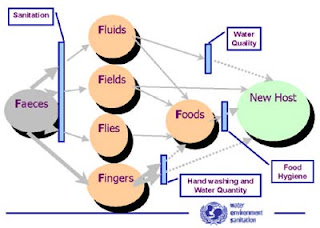 If our aim is to reduce the spread of diseases in Africa, we have to consider that providing new water wells all over the place is not necessarily the most effective way to address the problem, even if it does sound good to donors and makes for a great photo op. What if there are more effective ways to limit the spread of disease? What if we took all the money people are donating to build wells and put it towards this solution instead? Could the funds stretch farther and the solutions reach more people? Would it be more sustainable over time?
I don’t claim to have an answer to this problem. I’m certainly not saying, “Don’t donate.” But I agree with the folks at GiveWell who suggest that we should put our money primarily into projects that can report some quantifiable positive result, not just anecdotes.
*For GiveWell's full analysis of water charities (interesting and readable, I promise), click here.
*For a list of charities highly rated by GiveWell, click here.
*For GiveWell's take on donations toward Japan earthquake/tsunami relief (interesting!), click here.
Most prospective donors make decisions about where to give their money based on their own personal feelings and interests. For example, if I feel strongly about the AIDS crisis in Africa, I will donate heavily to organizations who claim to be doing something about it. If I am or know a cancer survivor or victim, I might choose to donate to a group aiming to find a cure. Others may feel strongly about environmental issues such as clean water and air, global climate change, etc. Once we have made the decision to donate, most people look no further than the organization’s own website or printed materials to make our final decision. The folks behind GiveWell knew or suspected that many—if not most—charity organizations overstate their effectiveness, and this causes donor dollars to go down a black hole rather than getting to people who could actually make good use of the funds.


It’s not just a question of abandoned wells, however. You have to consider what it is that these wells are supposed to accomplish. Why did we decide the people needed a well in the first place? The answer, of course, is that clean drinking water reduces the spread of disease. Unfortunately, water is only one of the ways that disease is spread and not necessarily the main one. Take a look at the diagram below:
I don’t claim to have an answer to this problem. I’m certainly not saying, “Don’t donate.” But I agree with the folks at GiveWell who suggest that we should put our money primarily into projects that can report some quantifiable positive result, not just anecdotes.
*For GiveWell's full analysis of water charities (interesting and readable, I promise), click here.
*For a list of charities highly rated by GiveWell, click here.
*For GiveWell's take on donations toward Japan earthquake/tsunami relief (interesting!), click here.
Going Veggie!
I was spending Christmas with my wonderful in-laws last year. My mother-in-law is all gluten-free these days and she had been given The Moosewood Cookbook as a gift. I think I read through the whole thing about 3 times cover to cover in the lazy, cozy days after the holiday, and I decided (first) to buy my own copy or risk ruining Mom’s new one, and (second) to become a vegetarian for one year, starting on January 1st.
I’d never even considered being vegetarian before. Being raised on a small, all-natural, grass-fed beef farm (with easy access to fresh local chicken and pork as well), I didn’t think I would be able to give meat up. But I needed some kind of catalyst to get me thinking more about what I eat, and I do enjoy a challenge. Now here I am almost three months in and I am doing (and feeling) great!
The earliest known vegetarians were from the areas of current-day India and Greece and lived in the 6th Century BCE. These people made the conscious decision to avoid meat as an act of nonviolence toward animals. Today there are many reasons for going veggie. Some people just don’t like the taste of meat, some believe killing animals for food is cruel, some take up the lifestyle for its health benefits, or to make some kind of political statement, or to be “in” with a certain crowd, or to save money on food.

There are also many different types of vegetarians. Ovo-vegetarians eat eggs but not dairy products. Lacto-vegetarians eat dairy but not eggs. You can guess what ovo-lacto veggies eat. Someone who excludes ALL animal products including eggs, dairy, and honey is a vegan. As for me, I’m technically a pescetarian because I eat fish, but no other meats. I do eat eggs and cheese. As for the health of all these options, some early studies have shown that pescatarians and occasional meat-eaters (people who eat meat only once or twice a week) have the longest lifespan. Strict vegetarians (no fish) and meat-eaters tie for second, followed by vegans. These studies are young, so the outcomes may change as we continue to study the health effects of different diets.
Vegetarians tend to have lower body mass index, lower levels of cholesterol, lower blood pressure, and less incidence of heart disease, hypertension, type 2 diabetes, renal disease, osteoporosis, dementias such as Alzheimer’s disease and other disorders. Some people wonder if a vegetarian diet can provide sufficient nutrition, but studies show most vegetarians have no noteworthy nutritional disadvantages. Protein is widely known for being a “meat” thing, but in fact protein comes from many vegetable sources as well and vegetarian diets easily meet these daily requirements (even for athletes who tend to need a lot of protein). Vitamin B12 can be a tough one for vegans, but is readily available in fish, eggs, and dairy. Vegetarian levels of iron, calcium, fatty acids, and other vitamins tend to be right on par with meat-eaters.

People always ask me if it is hard to be a vegetarian. It really hasn’t been too difficult for me, probably because I’m taking it as a personal challenge. My husband made the spur-of-the-moment decision to join me in veggie-land “in support”, and he’s been having a much harder time (and has cheated a couple times already I have to say, so thanks for the support, honey). : ) Mostly I’ve just been enjoying creating and cooking more meals at home, eating a lot more fresh produce, and trying out new recipes.
Here is a recipe I invented that is so good you won’t even realize it’s a meat-free dish:
Jillian’s Yummy Baked Ravioli
1 bag frozen ravioli, cooked according to package directions
1 large jar of pasta sauce (choose a yummy-sounding one like four cheese or basil garlic)
1/4 medium onion, finely chopped
4 garlic cloves, finely chopped
3 cups fresh or frozen assorted veggies, cut into bite-size pieces (I used broccoli, carrots, zucchini, and peas, but feel free to use your favorites)
3 tablespoons cream cheese
1 cup grated cheddar
1/4 cup bread crumbs (flavored okay, homemade is best)
Olive oil
In large saucepan, heat a little bit of olive oil over medium-high heat. When heated, add chopped onion and garlic and sauté for about 4 minutes. Add additional veggies and sauté until they reach desired softness. You may want to add a little more oil to veggies. Pour sauce into veggie mixture and heat through. Add cream cheese and stir until fully melted in the sauce.
Place cooked, hot raviolis in a 9x13in glass baking dish. Pour sauce and mix in with ravioli. Mix grated cheese and bread crumbs together, sprinkle evenly over the top. Bake at 350 degrees for 20 minutes. Garlic bread and garden salad make great sides!
 Enjoy!
I’d never even considered being vegetarian before. Being raised on a small, all-natural, grass-fed beef farm (with easy access to fresh local chicken and pork as well), I didn’t think I would be able to give meat up. But I needed some kind of catalyst to get me thinking more about what I eat, and I do enjoy a challenge. Now here I am almost three months in and I am doing (and feeling) great!
The earliest known vegetarians were from the areas of current-day India and Greece and lived in the 6th Century BCE. These people made the conscious decision to avoid meat as an act of nonviolence toward animals. Today there are many reasons for going veggie. Some people just don’t like the taste of meat, some believe killing animals for food is cruel, some take up the lifestyle for its health benefits, or to make some kind of political statement, or to be “in” with a certain crowd, or to save money on food.

There are also many different types of vegetarians. Ovo-vegetarians eat eggs but not dairy products. Lacto-vegetarians eat dairy but not eggs. You can guess what ovo-lacto veggies eat. Someone who excludes ALL animal products including eggs, dairy, and honey is a vegan. As for me, I’m technically a pescetarian because I eat fish, but no other meats. I do eat eggs and cheese. As for the health of all these options, some early studies have shown that pescatarians and occasional meat-eaters (people who eat meat only once or twice a week) have the longest lifespan. Strict vegetarians (no fish) and meat-eaters tie for second, followed by vegans. These studies are young, so the outcomes may change as we continue to study the health effects of different diets.
Vegetarians tend to have lower body mass index, lower levels of cholesterol, lower blood pressure, and less incidence of heart disease, hypertension, type 2 diabetes, renal disease, osteoporosis, dementias such as Alzheimer’s disease and other disorders. Some people wonder if a vegetarian diet can provide sufficient nutrition, but studies show most vegetarians have no noteworthy nutritional disadvantages. Protein is widely known for being a “meat” thing, but in fact protein comes from many vegetable sources as well and vegetarian diets easily meet these daily requirements (even for athletes who tend to need a lot of protein). Vitamin B12 can be a tough one for vegans, but is readily available in fish, eggs, and dairy. Vegetarian levels of iron, calcium, fatty acids, and other vitamins tend to be right on par with meat-eaters.

People always ask me if it is hard to be a vegetarian. It really hasn’t been too difficult for me, probably because I’m taking it as a personal challenge. My husband made the spur-of-the-moment decision to join me in veggie-land “in support”, and he’s been having a much harder time (and has cheated a couple times already I have to say, so thanks for the support, honey). : ) Mostly I’ve just been enjoying creating and cooking more meals at home, eating a lot more fresh produce, and trying out new recipes.
Here is a recipe I invented that is so good you won’t even realize it’s a meat-free dish:
Jillian’s Yummy Baked Ravioli
1 bag frozen ravioli, cooked according to package directions
1 large jar of pasta sauce (choose a yummy-sounding one like four cheese or basil garlic)
1/4 medium onion, finely chopped
4 garlic cloves, finely chopped
3 cups fresh or frozen assorted veggies, cut into bite-size pieces (I used broccoli, carrots, zucchini, and peas, but feel free to use your favorites)
3 tablespoons cream cheese
1 cup grated cheddar
1/4 cup bread crumbs (flavored okay, homemade is best)
Olive oil
In large saucepan, heat a little bit of olive oil over medium-high heat. When heated, add chopped onion and garlic and sauté for about 4 minutes. Add additional veggies and sauté until they reach desired softness. You may want to add a little more oil to veggies. Pour sauce into veggie mixture and heat through. Add cream cheese and stir until fully melted in the sauce.
Place cooked, hot raviolis in a 9x13in glass baking dish. Pour sauce and mix in with ravioli. Mix grated cheese and bread crumbs together, sprinkle evenly over the top. Bake at 350 degrees for 20 minutes. Garlic bread and garden salad make great sides!

Friday, August 27, 2010
MIKA
Music I am currently (and probably temporarily) obsessed with:
(Yes, you have to watch all 3 videos. No, you may not just watch the first one. No, you may not just watch the first thirty seconds of each one and then comment as if you have an informed opinion. No, I don't care that you are trying to watch this at work and the third video happens to feature a guy dancing (prancing?) around in his underwear) : )
BTW, I love all these, but they are in order from best to not-quite-as-best. : )
(Yes, you have to watch all 3 videos. No, you may not just watch the first one. No, you may not just watch the first thirty seconds of each one and then comment as if you have an informed opinion. No, I don't care that you are trying to watch this at work and the third video happens to feature a guy dancing (prancing?) around in his underwear) : )
BTW, I love all these, but they are in order from best to not-quite-as-best. : )
Friday, August 6, 2010
Yearbook Photos
Thanks to Troy and Laura (and my slow workdays) for these gems:

Ah, 1960. What a lovely year...

I was a good girl in 1966

1980, not quite fully into my crazy grunge period yet...

Ah, there it is. 1984!

I think I look just like Jaima in this photo (Jaima of 1992, not Jaima of 2010)

But things finally started coming together by 2000. Whew!
Ah, 1960. What a lovely year...
I was a good girl in 1966
1980, not quite fully into my crazy grunge period yet...
Ah, there it is. 1984!
I think I look just like Jaima in this photo (Jaima of 1992, not Jaima of 2010)
But things finally started coming together by 2000. Whew!
Wednesday, August 4, 2010
Solar Tsunami
As many of you may know, this week held some pretty cool solar activity. Four large coronal mass ejections took place, allowing for fabulous aurora borealis viewing on Earth. Coronal Mass Ejections (CMEs) are similar to and related to solar flares, but the relationship is not yet fully understood. Flares generally produce a visible, well…flare.., which shoots away from the sun. As you can see from this video, no flares were visible during these recent events, though you can glimpse the power of a large CME.
CMEs of this magnitude are cool because they cause such bright northern lights that folks in non-polar regions have a good chance of seeing them. Unfortunately, they also may knock out some unprotected parts of the power grid and mess with satellites.
Nevertheless, the sun is cool (figuratively speaking). Also check out this crazy-awesome photo:

This image is an extreme ultraviolet snapshot from the Solar Dynamics Observatory. It shows the sun's northern hemisphere in mid-eruption. Different colors represent different gas temperatures ranging from ~1 to 2 million degrees K.
*Note: "Solar Tsunami" would be an excellent band name.
CMEs of this magnitude are cool because they cause such bright northern lights that folks in non-polar regions have a good chance of seeing them. Unfortunately, they also may knock out some unprotected parts of the power grid and mess with satellites.
Nevertheless, the sun is cool (figuratively speaking). Also check out this crazy-awesome photo:

This image is an extreme ultraviolet snapshot from the Solar Dynamics Observatory. It shows the sun's northern hemisphere in mid-eruption. Different colors represent different gas temperatures ranging from ~1 to 2 million degrees K.
*Note: "Solar Tsunami" would be an excellent band name.
Subscribe to:
Posts (Atom)